







Choosing a joint injection: what matters beyond the brand name?

Choosing a joint injection: what matters beyond the brand name?
When joint pain starts affecting your walking, exercise or sleep, you want to know what might help.
Researching injections can leave you with a long list of brands, different prices and plenty of scientific terminology.
But the questions that matter are usually straightforward.
Why this injection? What results support it? And what happens after the appointment?
Before spending money on treatment, you deserve answers you can understand.
This guide focuses on hyaluronic acid injections for osteoarthritis, particularly knee osteoarthritis, and explains why Monovisc, its relationship with Cingal and the wider support available through Joint Pain Freedom deserve consideration.
Monovisc, Ostenil Plus, Durolane, Sinovial and Sinogel: what is the difference? They are all hyaluronic acid injections.
These are different branded formulations used for joint treatment. They should not be assumed to be identical simply because they contain hyaluronic acid, often shortened to HA.
Differences can include the amount of HA, its molecular characteristics, how it is stabilised and the clinical research supporting the finished product.
For example:
- Monovisc
Contains 88 mg of lightly cross-linked HA in a single 4 ml injection, with published high-level placebo-controlled knee osteoarthritis research. - Ostenil Plus
Contains 40 mg of sodium hyaluronate in 2 ml, with added mannitol but no cross-links (meaning it lasts less time in the joint) - Durolane
Has published randomised research comparing a single injection with a course of another HA treatment. Only 60mg of HA is delivered per injection and carries a very large molecule of HA, with a clinically reported 10% of patients experiencing pain. - Sinovial
A product family that includes hybrid HA formulations. It is important to identify the exact version being offered, as this is a technology derived from aeathetics / bueaty therapy. - Sinogel
Combines sodium hyaluronate and sodium chondroitin in a hybrid formulation, a new option without the depth of control trial study data at the same level as Monovisc (or Cingal)
These distinctions describe the products; they are not a ranking of effectiveness. A larger dose or a more technical name does not, on its own, establish a better clinical result.
You do not need to become an expert in each brand. Your clinician should be able to explain why the particular formulation and its evidence make sense for you. But it is important to challenge choices if you are not sure about what you are being offered.
Why we support Monovisc
Our confidence in Monovisc comes from several things together: its established history, defined formulation, single-injection convenience and published patient outcomes.
A history extending back to 2008
Monovisc’s European sales began in 2008. Anika developed it as a single-injection osteoarthritis treatment using its proprietary HA technology. It has not been derived from a previous use away from joint pain.
Anika now reports approximately five million Monovisc injections administered worldwide. That manufacturer-reported experience provides context alongside the published clinical research.
For patients, this means there is an established treatment history to examine, rather than relying only on the promise of something new.
A carefully formulated HA treatment
Monovisc delivers 88 mg of HA in one 4 ml injection. Its HA is produced through bacterial fermentation and lightly cross-linked to slow its breakdown within the joint.
HA naturally contributes to the lubricating properties of joint fluid. The formulation of an injectable HA product involves more than choosing a dose: molecular characteristics and stabilisation also matter.
Laboratory research by Smith and Ghosh showed that HA’s molecular size and concentration influenced HA production by human joint-lining cells. This supports the importance of formulation, which is a large part of how Monovisc has been formulated.
The important additional step is clinical evidence for the finished product. Monovisc has that.
Published evidence in people with knee osteoarthritis
A randomised, double-blind study involving 369 patients compared Monovisc with a saline injection.
Monovisc achieved a statistically higher rate of treatment success on the study’s defined pain outcome through 26 weeks. The authors reported clinically meaningful pain relief within two weeks.
That provides a concrete basis for discussing treatment: measured outcomes in patients, alongside the explanation of how the formulation works.
What do the published pain scores show?
A separate trial studied Monovisc, Cingal and saline within the same study.
Researchers used WOMAC, a recognised osteoarthritis questionnaire, to measure pain.
For Monovisc
- Average pain reduction at 12 weeks – 64%
- Average pain reduction at 26 weeks – 65%
For Cingal
- Average pain reduction at 12 weeks – 70%
- Average pain reduction at 26 weeks – 72%
Saline control (many studies do not include this, it adds excellent credibility)
- Average pain reduction at 12 weeks – 52%
- Average pain reduction at 26 weeks – 56%
These figures are average reductions from patients’ starting pain scores. They are not success rates or the percentage advantage over placebo. Individual results vary, and the saline results help put the improvements into context.
For someone considering Monovisc, the study demonstrates substantial average symptom improvement maintained over six months.
Where Cingal fits when inflammation needs attention
Sometimes a clinician wants to address inflammation alongside longer-lasting symptom management.
Cingal combines the Monovisc HA formulation with an anti-inflammatory corticosteroid in one ready-to-use injection. It contains 88 mg of HA and 18 mg of triamcinolone hexacetonide.
The corticosteroid provides an early anti-inflammatory action while the HA works alongside it. Both are delivered together.
In the published comparison above, Cingal produced significantly greater pain improvement than Monovisc at weeks one and three. Outcomes were similar from six weeks through to six months.
This gives your clinician two related options: the established HA formulation on its own, or that formulation with an added corticosteroid when appropriate.
Could treatment start with Cingal and continue with Monovisc?
For some patients, that may be a sensible option to discuss.
A clinician may initially recommend Cingal when an anti-inflammatory component is appropriate. If symptoms return later and further HA treatment is suitable, Monovisc offers an option without another corticosteroid.
Having a steroid-containing injection once does not mean every subsequent injection needs to contain a steroid.
Your clinician should reassess your symptoms, your response to the previous treatment and your current needs before recommending what comes next.
This is a personalised treatment option, rather than a fixed programme. The trials described here studied the individual injections, not a planned Cingal-then-Monovisc sequence.
Where a brace may help
Pain management can also involve supporting how you move and load the joint.
For selected patients, a clinician may recommend a brace to address instability or abnormal loading, particularly where this could help them exercise and improve function. Bracing is not routinely needed by everyone with osteoarthritis.
Through Joint Pain Freedom, patients can explore bracing options alongside information about injections and rehabilitation.
Your clinician can advise whether a brace is appropriate, which type suits your knee and how it should fit into your activity plan.
An injection and a brace have different roles. Their suitability should be assessed individually; using both does not automatically guarantee a better outcome.
What JPF brings around the injection
Patients want choices, but they also want help understanding how those choices fit together.
That is the approach behind Joint Pain Freedom. Alongside information about Cingal and Monovisc, we help patients understand bracing, rehabilitation and other aspects of managing joint symptoms. The aim is to support a better conversation with your clinician about both treatment now and what might be appropriate later.
For one person, that may mean Cingal followed by reassessment and consideration of Monovisc if symptoms return. For another, it may mean Monovisc from the outset, a suitable brace or a different treatment altogether.
The value is having options that can adapt to your needs, with a clinician guiding the decisions.
What should you avoid when choosing an injection?
Be cautious when:
- A product is described as better simply because it is newer or has a more complicated name or fancy science.
- A percentage is quoted without explaining what was measured.
- Results from separate studies are presented as though the brands were directly compared.
- Treatment is recommended without discussing diagnosis, alternatives, risks and total cost.
- There is no explanation of follow-up or what happens if treatment does not help.
A good consultation should make the decision clearer.
Thinking about the longer term, if your goal is to explore non-surgical care, explain that to your clinician.
Symptom relief may help you participate more comfortably in everyday activity and rehabilitation. Exercise and weight management, where appropriate remain important parts of osteoarthritis care.
Neither Monovisc nor Cingal has been established as a way to prevent knee replacement. If pain and disability remain substantial, surgery may still be the right option. But in general, there is data suggesting they may delay eventual joint replacement. No HA injection can claim anything more than this.
The aim is to make informed decisions at each stage, based on how your joint is affecting your life.
A clear reason to discuss Monovisc and Cingal
Monovisc brings together an established history, a defined HA formulation and published clinical evidence in a single-injection treatment.
Cingal adds the option of an anti-inflammatory component within the same HA treatment family.
Joint Pain Freedom brings information about the wider choices around them, including bracing where your clinician considers it helpful.
Before paying for an injection, understand the product, the evidence and the plan around it.
Explore our Monovisc, Cingal and bracing information, then discuss your options with your treating clinician.
Important treatment information
Results vary, and injections are not suitable for everyone. Possible adverse effects include pain and swelling; your clinician should explain other risks, check contraindications and assess the additional corticosteroid considerations with Cingal.
NICE currently recommends against offering intra-articular hyaluronan injections for osteoarthritis. If HA treatment is proposed, your clinician should explain this guidance, the evidence supporting their recommendation and the alternatives before you decide.
Related guides

Hyaluronic acid

Joint injections
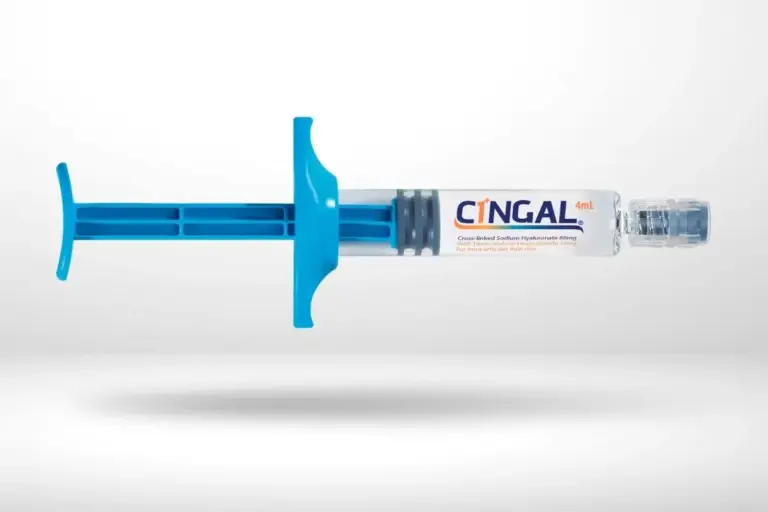
Cingal for joint pain
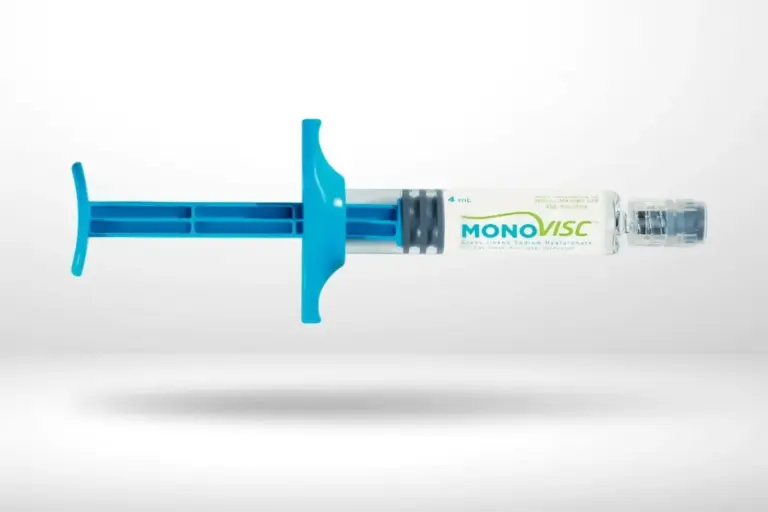
Monovisc for joint pain

Compression support

Bracing
More from the community

When knee pain keeps interrupting the things you enjoy, it is natural to wonder what else might help.


Cingal offers a powerful anti-inflammatory, lasting long by protecting the joint

Useful downloads
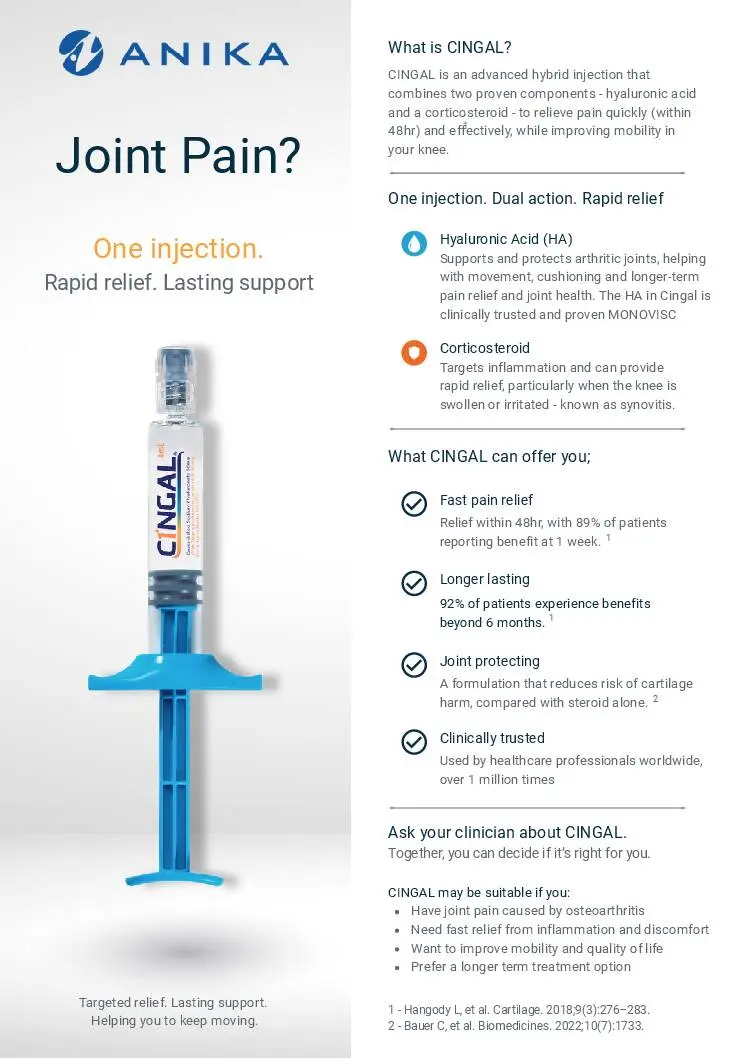
Cingal Overview Guide
Manufactured by world leader in joint care treatments, Anika. Learn more about breakthrough injection Cingal
Open the PDF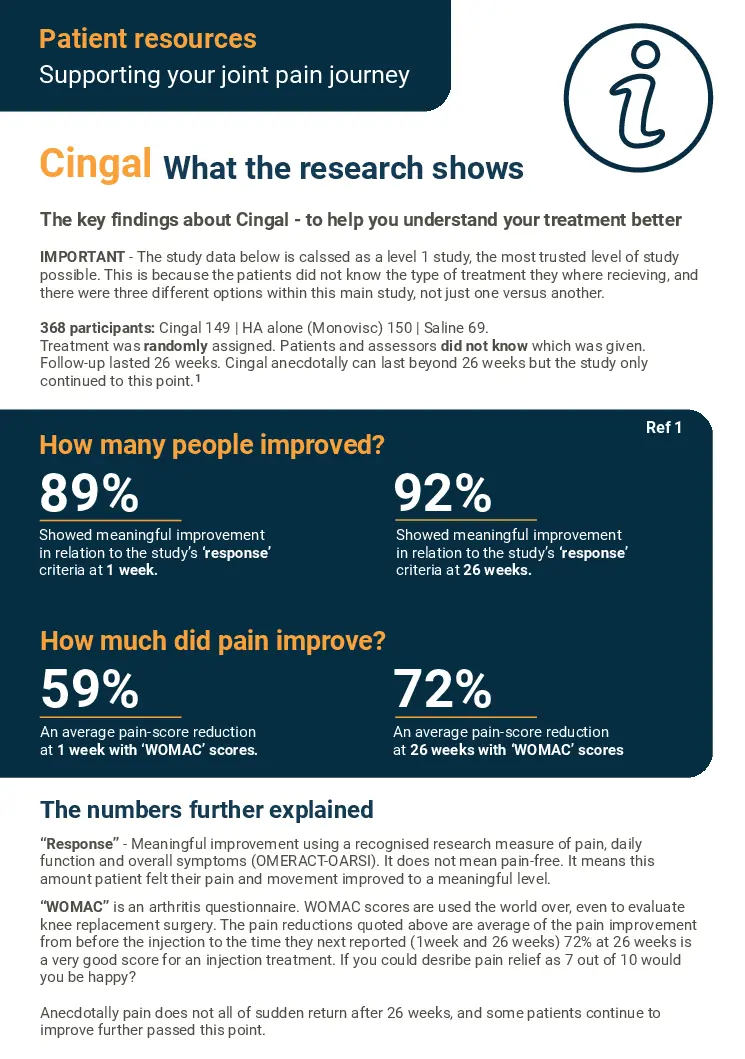
Cingal Study Data Information
Cingal study data for joint pain relief- easy to understand
Open the PDF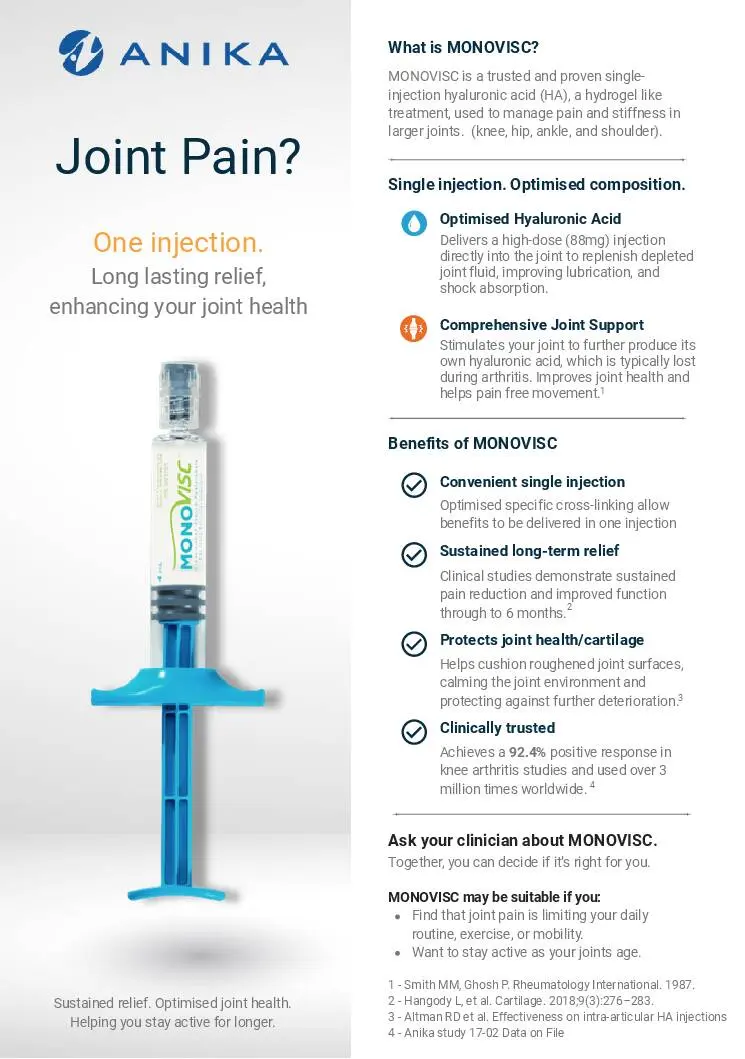
Monovisc Overview Guide
Manufactured by world leaders in joint care treatments, Anika. Monovisc has been trusted for joint pain treatment over 3 million times worldwide.
Open the PDF
Talking about your joint pain
Questions to take to your appointment, covering your symptoms, your treatment options and what matters most to you.
Open the PDF