







Joint injections for arthritis: comparing your options

You have shortened your walks. Changed your training. Started avoiding movements that used to feel straightforward.
Perhaps you have already tried treatment, or been offered a steroid injection, and want to understand what else is available.
When joint pain keeps interrupting your life, it makes sense to review your options. An injection may help, but so might a well-chosen support, a brace or a change to your rehabilitation plan.
Understanding how these treatments fit together can help you have a more useful conversation with your clinician.
When is it time to discuss an injection?
There is no single point when everyone with osteoarthritis needs an injection. The decision depends on what is causing your symptoms, what you have already tried and how much pain is affecting your life.
It may be time to review your treatment if:
- Pain is regularly limiting walking, work, sleep or exercise.
- You are struggling to progress with strengthening or rehabilitation.
- Your current treatment is not providing enough relief.
- The benefit from a previous treatment has worn off.
- An assessment should establish whether the pain is coming from the joint and whether an injection is appropriate.
- The aim is to make movement more manageable and help you participate in a wider treatment plan.
Exercise, strength work and weight management where appropriate remain central to managing osteoarthritis. An injection may support that work, but does not replace it.
Is a steroid injection the only option?
A corticosteroid injection, often called a cortisone injection, is a familiar treatment for joint pain. It reduces inflammation and can provide short-term relief. And although a useful option to quickly control inflammation, repeated steroid injections can affect the health of the joint in a negative way.
NICE guidance supports considering corticosteroid injections when other medicines are ineffective or unsuitable, or to help someone participate in therapeutic exercise. Patients should be told that relief is generally short-term, around two to ten weeks.
Steroid alone is not the only injection available. Other options include hyaluronic acid and treatments combining hyaluronic acid with a corticosteroid.
These treatments differ in their ingredients, evidence, intended use and cost. Availability also differs: Hyaluronic acid, PRP or hydrogel injections for osteoarthritis are offered in some NHS practices, but more so within private practice. Your clinician should explain the evidence across all of them.
Understanding hyaluronic acid injections
Hyaluronic acid, often shortened to HA, is naturally present in the fluid within your joints. It contributes to lubrication and helps the joint move smoothly.
HA injections are used to help manage osteoarthritis symptoms longer term. Some contain HA alone; others combine it with another ingredient.
The important question is which treatment, if any, is appropriate for your joint, your symptoms and your goals.
Cingal: hyaluronic acid and corticosteroid together
Cingal combines a high dose of optimised hyaluronic acid with a corticosteroid called triamcinolone hexacetonide in a single injection.
The corticosteroid provides an earlier anti-inflammatory effect, while the HA component supports longer-lasting symptom relief. Cingal therefore still contains steroid, something that matters when discussing suitability. It is worth noting that the steroid type within Cingal is safer and generally more effective type of steroid.
In a randomised clinical trial involving 368 people with knee osteoarthritis, the Cingal group achieved an average 72% reduction in pain at 26 weeks. A 92% responder rate was reported using established clinical improvement criteria.
A responder is someone who meets those improvement criteria, not necessarily someone who becomes pain-free. These are study results, not a guarantee of an individual outcome, but do give a very good indication.
The trial included knee OA grades I–III. Its results should not be applied automatically to end-stage disease or other joints. Cingal’s expanded European indications include the knee, hip, shoulder and ankle.
Although Cingal contains a steroid type, there have been scientific studies that suggest it does not cause the negative long-term effects some worry the steroid alone can produce.
Monovisc: a single-injection HA option without steroid
Monovisc contains a high dose of optimised hyaluronic acid without a corticosteroid.
It offers an option for patients and clinicians considering HA treatment without an added steroid component. It is administered as a single injection, with applications including the knee, hip, shoulder and ankle.
The likelihood and duration of benefit vary. Your clinician should explain the evidence for your particular joint and whether Monovisc is a reasonable option, but 7 out of 10 patients with mild to moderate osteoarthritis respond well, and a recent knee study showed that 92% at 38 weeks felt meaningful benefit for movement and pain reduction.
Orthovisc: another HA option, including smaller-joint discussions
Orthovisc is a non-crosslinked optimised hyaluronic acid treatment without corticosteroids.
It has an established history in knee osteoarthritis, commonly using a course of injections. Its European indication also covers synovial joints, and clinicians may consider it for smaller joints, including those in the hand or foot.
Smaller-joint treatment requires careful assessment of the exact joint, diagnosis and appropriate injection volume. The evidence is not equally strong across every joint, and the treatment schedule should follow the relevant product instructions.
What is meant by ‘optimised HA’
Optimised means that the type of cross-linked molecules and the actual molecular weight have been specifically developed, alongside the dose per injection, to give the longest-lasting effect of treatment. The injection alone not only helps but also supports the joint to produce its own hyaluronic acid, further helping the health of the joint.
Could compression or bracing be a sensible starting point?
Before deciding on an injection, it is worth asking whether support during movement could help.
For someone who wants to remain active, an appropriate sleeve or brace may be considered before an injection, or as part of the same management plan.
The choice depends on what support is needed. A compression sleeve and an unloading brace perform different jobs.
Compression sleeves: support during activity
A compression sleeve provides close-fitting support around the joint.
For some people, that can make activity feel more comfortable and supported. The Formfit Pro range includes supports designed for different body areas and needs.
A standard compression sleeve does not provide the same targeted unloading as an osteoarthritis brace. Fit, comfort and the reason for using it all matter.
Formfit Pro Knee OA: compression with unloading features
Formfit Pro Knee OA combines a sleeve-style design with features intended to provide unloading support for early-stage knee osteoarthritis.
It may be worth discussing if you want a relatively lightweight support and your symptoms suit this type of brace.
OA Ease: support and unloading for mild to moderate knee OA
Formfit OA Ease is a wraparound option designed for mild to moderate knee osteoarthritis.
It offers another approach where OA-specific support is appropriate. Your clinician can help you compare it with a sleeve-style support and assess which is more suitable and practical for you.
Unloading braces: reducing load through the affected compartment
When osteoarthritis predominantly affects one compartment of the knee, an unloading brace may help redistribute load away from that area during movement.
An Össur Unloader brace is designed for this purpose. It needs appropriate assessment, selection and fitting.
These supports are not a ladder everyone must climb. The right starting point depends on your symptoms, the pattern of your arthritis and how your knee functions.
How can a brace work alongside an injection?
An injection may help reduce symptoms within the joint. A suitable brace can provide support or alter loading while you move.
For some patients, both may have a place: symptom relief may make rehabilitation more manageable, while a brace supports particular activities.
That does not mean everyone needs both, or that wearing a brace has been proven to make an injection last longer.
NICE recommends selective use of braces and supports where joint instability or abnormal loading makes exercise difficult and the device is likely to improve movement and function. The decision should be based on a clear purpose, with a review of whether it is helping.
What about Arthrosamid?
You may have heard about Arthrosamid. It is a permanent, non-absorbable hydrogel implant used for knee osteoarthritis.
Its permanence deserves careful consideration. Antibiotics are required before treatment, and removal, if necessary, involves surgery. Patients should also tell healthcare professionals about the implant before future surgical or dental procedures.
A randomised comparison with a hyaluronic acid injection found comparable symptom outcomes, with more reported mild or moderate device-related reactions in the Arthrosamid group. No serious device-related reactions were reported in that trial.
Arthrosamid also carries a substantially higher upfront cost than many other injection options. Before choosing it, ask about the evidence, possible complications, implications for future care and the full cost.
A higher price does not, by itself, establish that a treatment is the better option for you.
What should you ask before choosing an injection?
A useful treatment discussion should cover:
- What is causing my pain, and is this treatment appropriate for it?
- What evidence is there for my joint and stage of osteoarthritis?
- How much improvement is realistic, and how long might it last?
- What are the risks, including any implications for my other health conditions?
- Could a sleeve or brace help before or alongside treatment?
- What rehabilitation and aftercare will I need?
- What is the full cost, and what happens if treatment does not help?
- All joint injections carry risks, including pain, swelling and infection. Steroid-containing treatments have additional considerations, such as a temporary rise in blood glucose. Your clinician should explain the risks relevant to you.
If symptoms remain severe and substantially affect your quality of life, assessment for surgery may also be appropriate. Repeated injections should not become an automatic substitute for reviewing the wider plan.
Find the right next step for you
You do not need to know which injection or brace you want before seeking advice.
Start with what is difficult now and what you would like to get back to. Walking further. Training more comfortably. Working with fewer interruptions. Feeling more confident in everyday movement.
At Joint Pain Freedom, you can explore the treatments and supports available, understand the questions to ask and find a clinic to discuss your options.
Clinical evidence: Hangody et al., Cartilage, 2018;9(3):276–283. Bliddal et al., Clinical and Experimental Rheumatology, 2024;42(9):1729–1735. NICE guideline NG226. Product information from Anika, Össur and the Arthrosamid Instructions for Use.
Related guides

Joint injections

Hyaluronic acid

Cingal for joint pain

Monovisc for joint pain

Orthovisc for joint pain

Could PRP help?

Compression support

Bracing
More from the community

When knee pain keeps interrupting the things you enjoy, it is natural to wonder what else might help.


A practical guide to treatment options, support tools and everyday strategies

Useful downloads
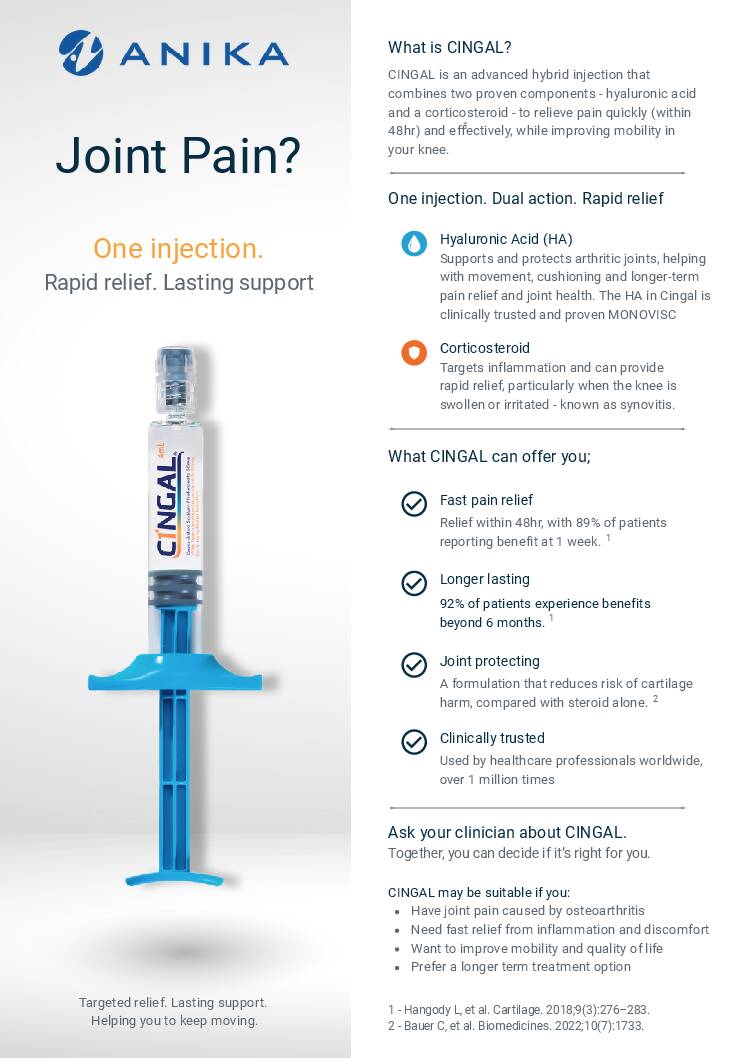
Cingal Overview Guide
Manufactured by world leader in joint care treatments, Anika. Learn more about breakthrough injection Cingal
Open the PDF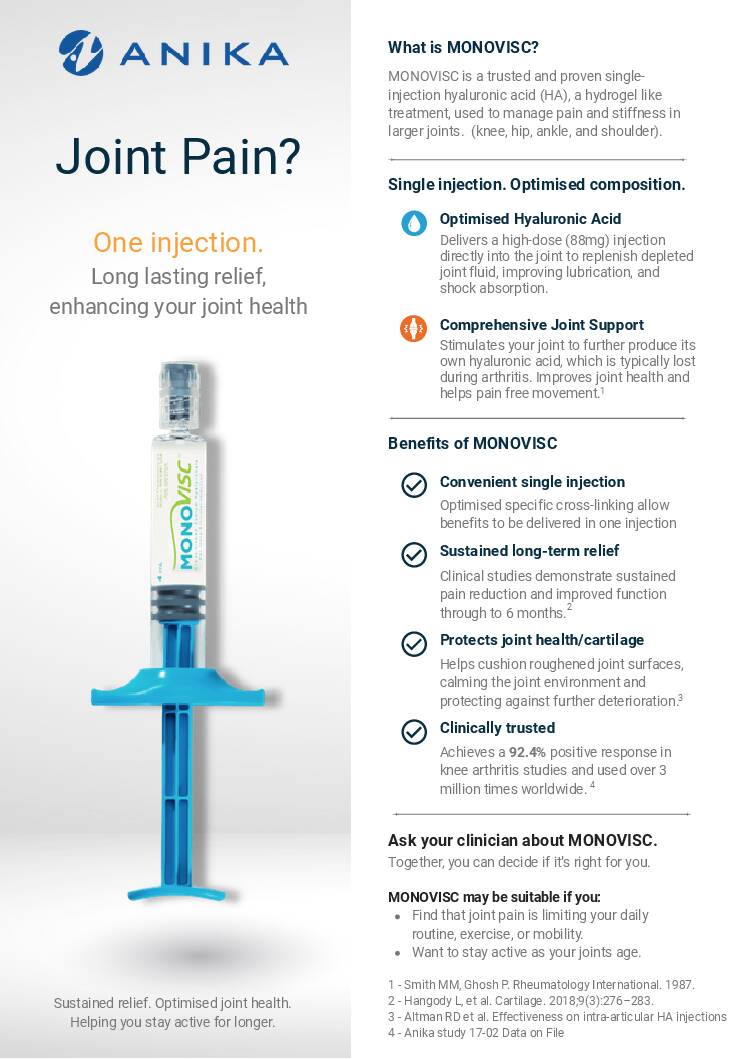
Monovisc Overview Guide
Manufactured by world leaders in joint care treatments, Anika. Monovisc has been trusted for joint pain treatment over 3 million times worldwide.
Open the PDF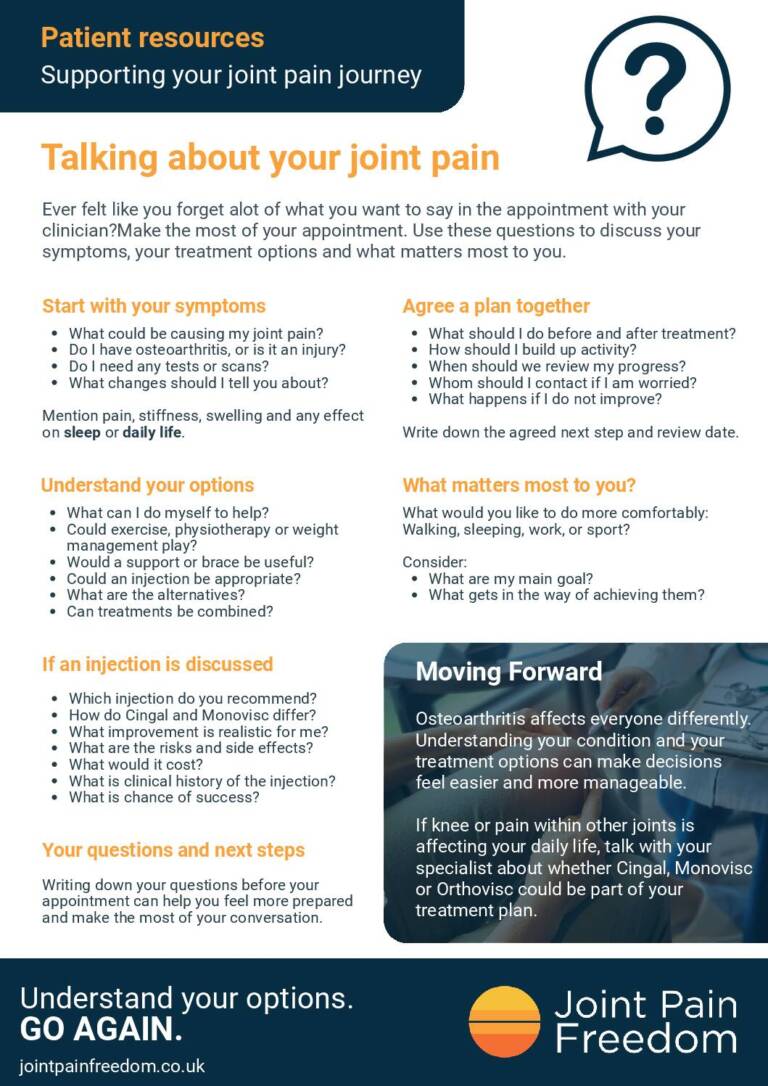
Talking about your joint pain
Questions to take to your appointment, covering your symptoms, your treatment options and what matters most to you.
Open the PDF